
HowLightsmartworks
UV2RED™ captures UV and higher-energy sunlight and re-emits part of that energy as red and near-infrared light.
It's built into the yarn. No device, no battery, no charging — the fabric does it whenever sunlight hits it.
Measured, not claimed. Every number on this page links to the test behind it — including what that test doesn't show.
What happens in the fabric
Three steps, no electronics
Sunlight is a mix of wavelengths. Ultraviolet sits at the short, high-energy end; red and near-infrared at the long end. UV2RED is a photonic material built into the polyester fiber itself — not a coating, not a finish — that absorbs part of the short end and re-emits part of that energy at the long end.
Sunlight in
UV, visible and infrared light arrive together. Ordinary fabric reflects some, absorbs some as heat, and passes some through — including some of the sun's own red and near-infrared.
UV2RED absorbs the higher-energy light
The photonic material inside the yarn absorbs a portion of the ultraviolet and other short-wavelength light. This is also why the fabric rates UPF 50+: very little UV gets through.
Additional red + near-infrared out
Part of the absorbed energy is re-emitted at longer wavelengths, roughly 650–950 nm. This is light the fabric generates, on top of the red and near-infrared sunlight that passes through it. No electronics, no battery — only light.
Blocking is not converting
UPF measures how much UV does not pass through a fabric. Photonic conversion measures how much red/NIR the material generates. Related, but measured separately.
Not every blocked photon becomes a red one
Some UV is reflected or scattered. Some absorbed energy is lost as heat. A portion is re-emitted as red and near-infrared. We don't claim the whole block is converted.
Generated, not filtered
The red/NIR from UV2RED adds to the sunlight's own red/NIR that any fabric lets through. The test below removes the sun's share so you can see the fabric's share on its own.
See the conversion
Take away the sun's red light. See what's left.
The cleanest way to prove a fabric is generating red and near-infrared light — rather than letting the sun's through — is to remove the sun's. That is what this bench test does.
Supply higher-energy light
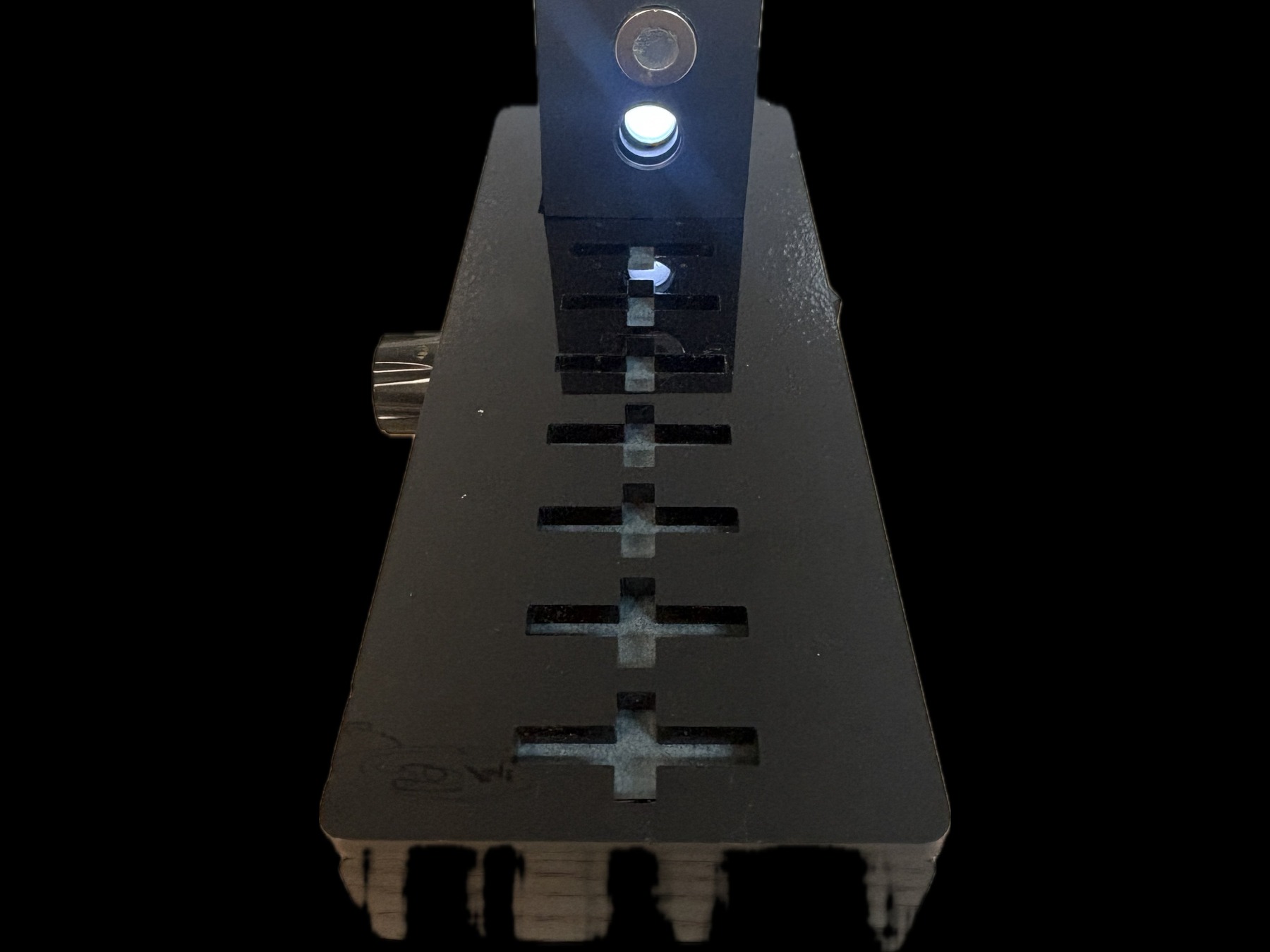
A calibrated Labsphere LED source delivers UV and short-wave light onto a fabric swatch held at a fixed distance.
Remove existing red and near-infrared
A 650 nm short-pass filter strips red and near-infrared from that light before it reaches the fabric. Now there is essentially none available to leak through.
Measure an ordinary fabric
Nike Pro dark grey polyester, the control: the detector reads 0.01 mW/cm² across 650–950 nm. Essentially nothing.
Measure the UV2RED fabric
Halo Midnight Sun mesh, same setup: 1.87 mW/cm², peaking at 776 nm.
Conclude
With no red or near-infrared coming in, the only place that signal can have come from is the fabric itself.
What this proves
- The material converts higher-energy light into red and near-infrared light.
- The signal is not ambient light passing through: the source's red/NIR was removed first.
- The effect is large enough to read on a handheld instrument in real time.
What it doesn't prove
- How much red/NIR reaches your skin in real sunlight. That's a different measurement — see +32% below.
- Which direction the light leaves the fabric. This test did not measure directionality.
- Any biological effect. This is an optical measurement of a textile.
- That all blocked UV becomes red/NIR. Some is reflected, scattered, or lost as heat.
You may see this test summarised as "187 times more." That is simply 1.87 ÷ 0.01. Read it precisely: in a filtered test where the control produces essentially zero, the UV2RED fabric's isolated output was 187 times larger. It is strong evidence the conversion is real. It is not a measure of how much more red and near-infrared light a wearer receives in sunlight, where most of the red/NIR at the skin is sunlight any fabric lets through.
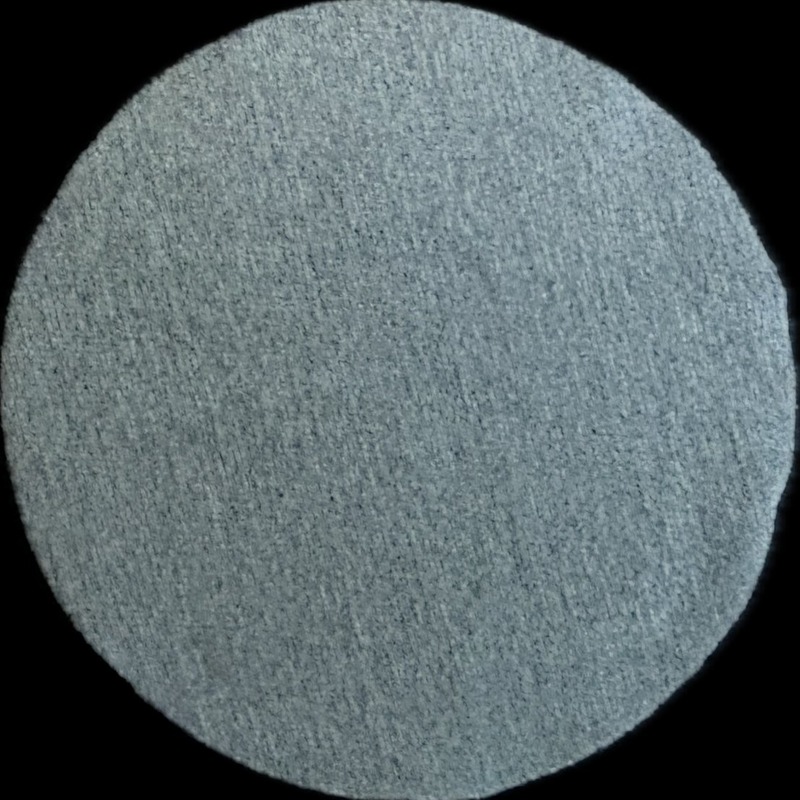
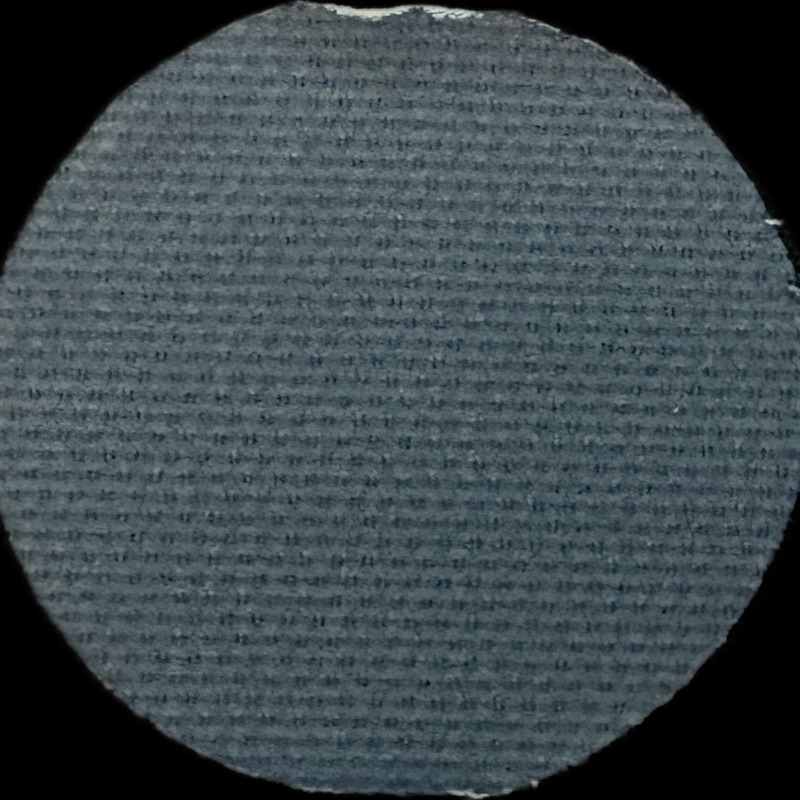
To the eye, nearly identical. To a spectrometer, not close.
What we measured
The primary spectrum, decoded
One chart, with everything you need to read it. Control versus UV2RED under the filtered test above.
With the sun's red and near-infrared removed, ordinary fabric goes dark in this band. UV2RED fabric still glows in it — 1.87 mW/cm², centred near 776 nm. That light was made by the fabric.
Three measurable outputs
What the fabric does, in numbers
Three separate measurements, three separate setups. Each one is shown with the fabric it was made on and the conditions it was made under.
Additional red and near-infrared light
In real sun, most of the red and near-infrared at your skin is sunlight that any fabric lets through. UV2RED adds to it. In this test — on a fabric with under half photonic fiber — the addition was 32%. That is the basis for the "30%+" figure.
Output varies with construction, colour, fiber content and sunlight; this is one fabric, one session. See what changes the number.
- Fabric
- Alpin Midnight Sun Heather leggings — 43% Lightsmart photonic polyester, 57% nylon and Lycra
- Conditions
- Outdoor, full sun, Charlotte, NC
- Instrument
- HopooColor HPCS330Pro spectroradiometer
- Method
- Total red/NIR reaching the skin side through the fabric (7.18) measured; the portion attributable to UV2RED conversion (1.72) isolated; the remainder (5.46) is what a similar-weight unmodified fabric passes
Baseline transmission plus a 32% uplift from conversion — passive, for as long as the fabric is in sunlight. Rounded, that is "30%+".
Ultraviolet protection
Thirteen laboratory reports, thirteen UPF 50+ ratings. UPF 50+ is the highest classification: at least 98% of UV is stopped at the fabric.
Many fabrics reach UPF 50+. What's different here is where some of that stopped energy goes: in a conventional fabric it is reflected or becomes heat; in UV2RED fabric a portion is re-emitted as red and near-infrared. UPF applies to the skin the garment covers.
- Reports
- 13, all rated UPF 50+
- Laboratories
- Intertek Taiwan (2024) · Precision Testing Labs (2018–2021)
- Method
- AATCC TM 183 — erythemally weighted UV transmittance
- UV-A blocked
- 93.3% – 99.95% across the 13 fabrics
- UV-B blocked
- 99.1% – 99.95% across the 13 fabrics
- Fabrics
- Polyester/spandex jerseys and mesh jerseys (150–190 g/m²), earlier Lumia-yarn fabrics and sleeves, NF-series knits
UPF is an uncapped ratio; several reports return values in the hundreds or above 1,000. For protection purposes read those as "50+". Full table in Go deeper.
Cooler under the fabric in direct sun
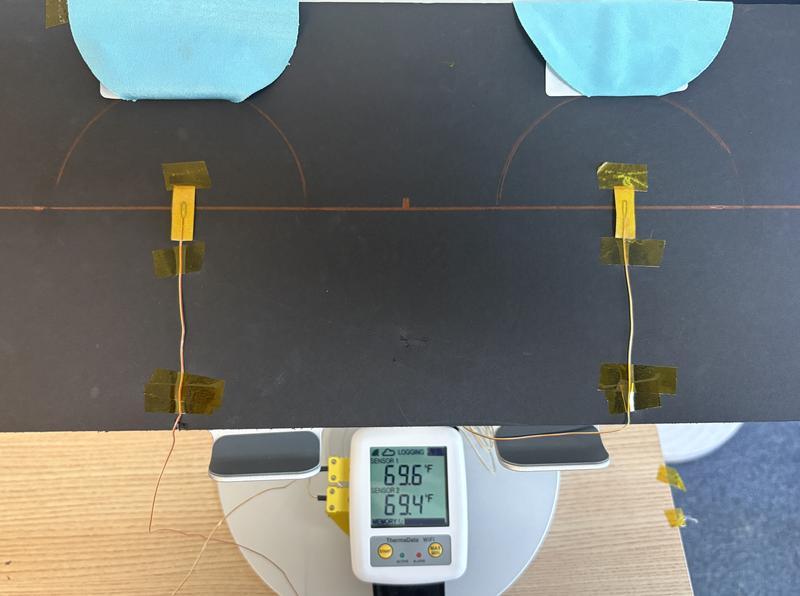
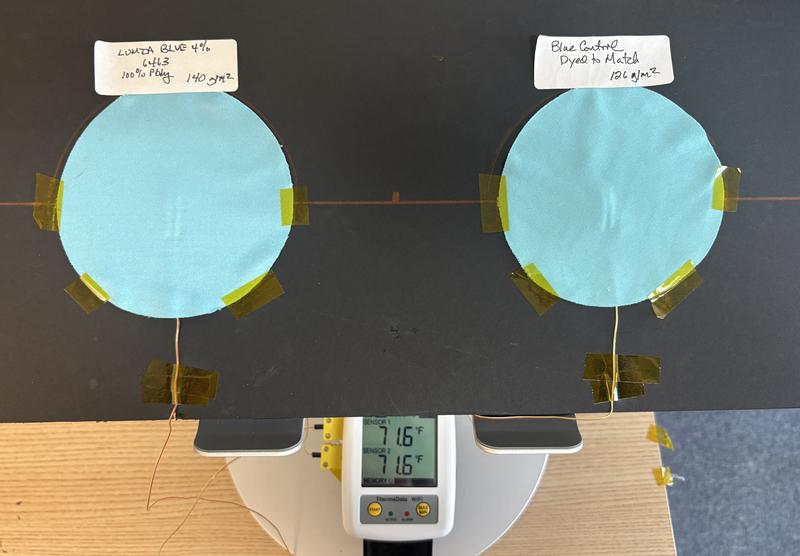
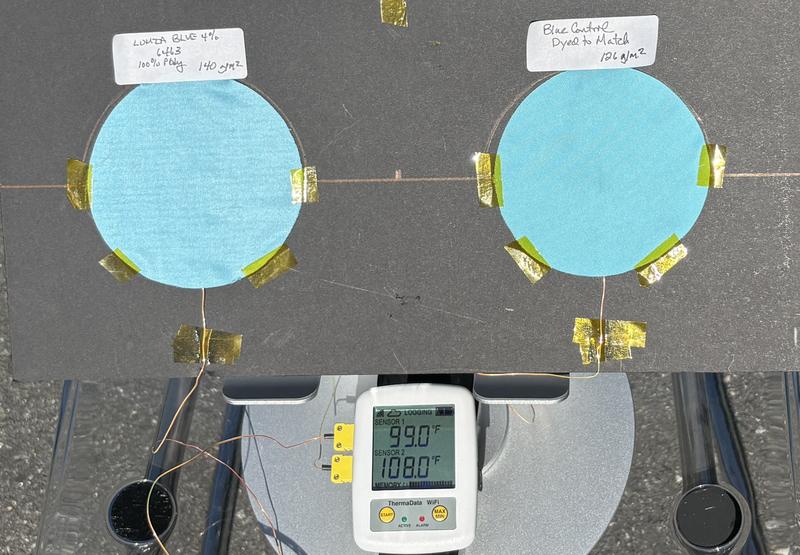
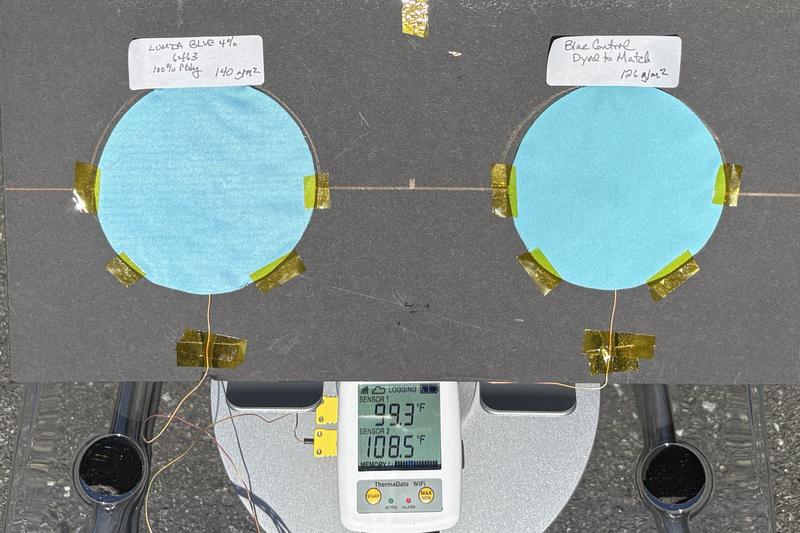
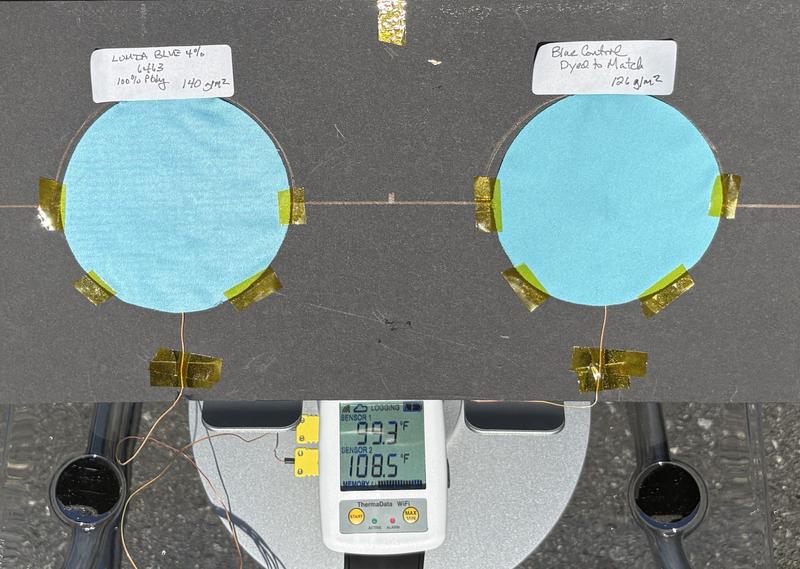
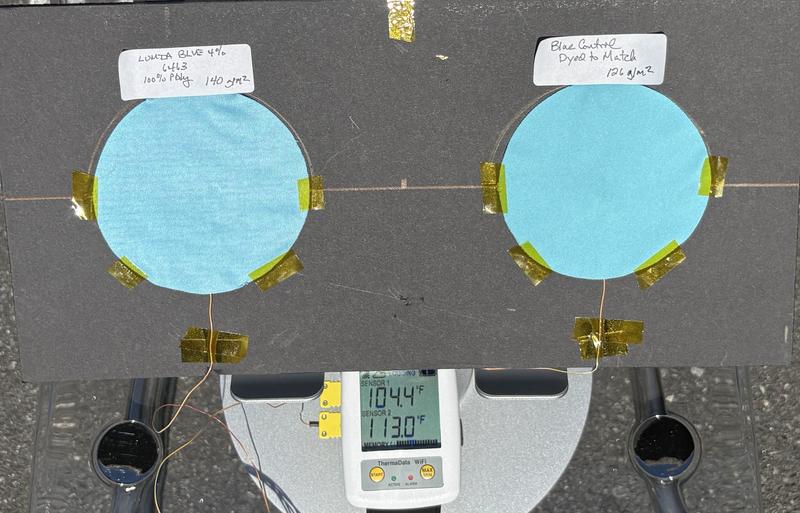
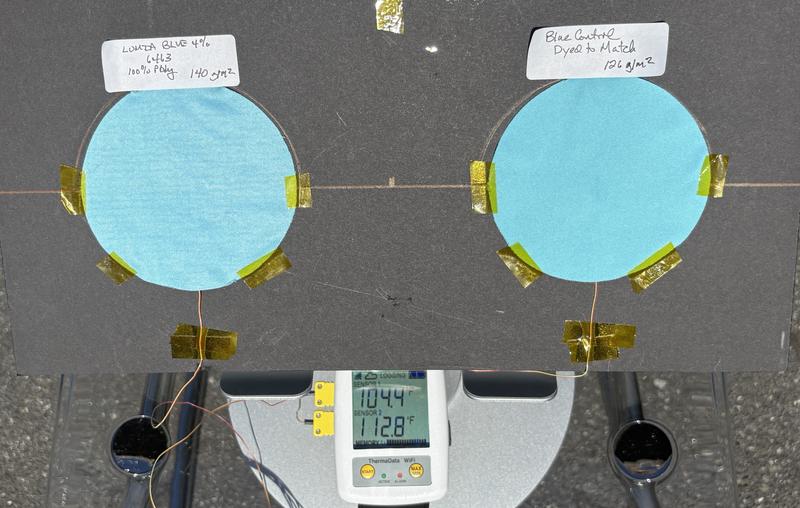
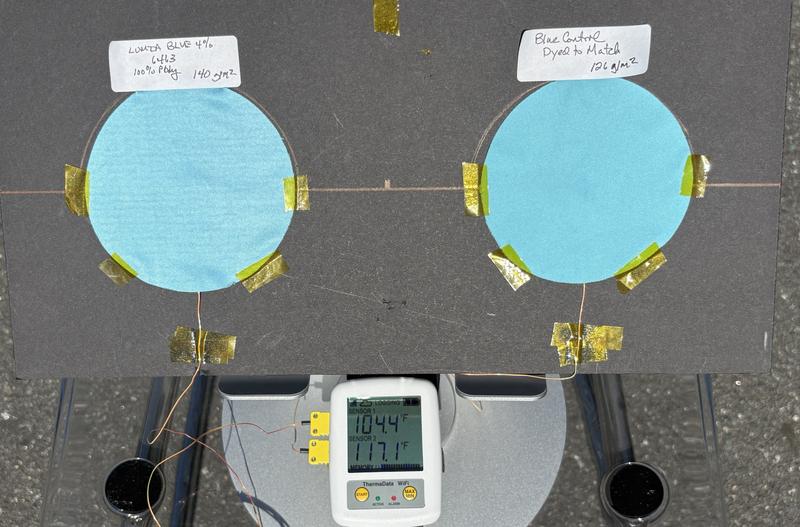
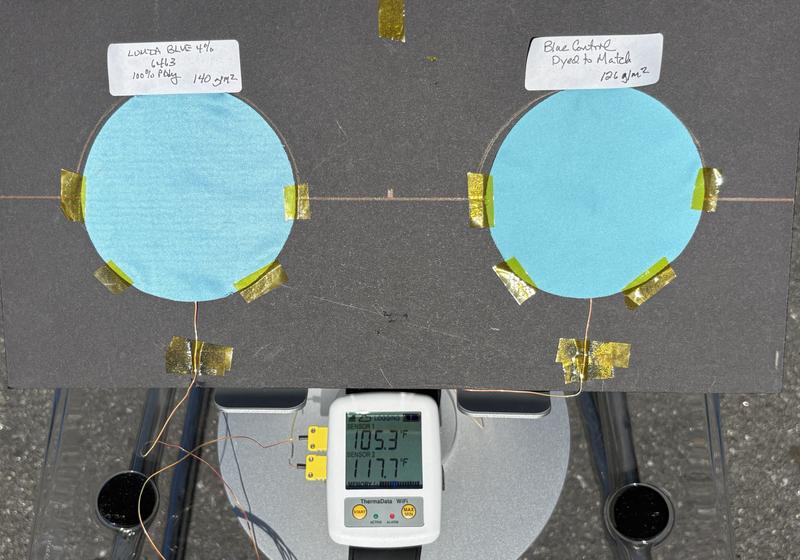
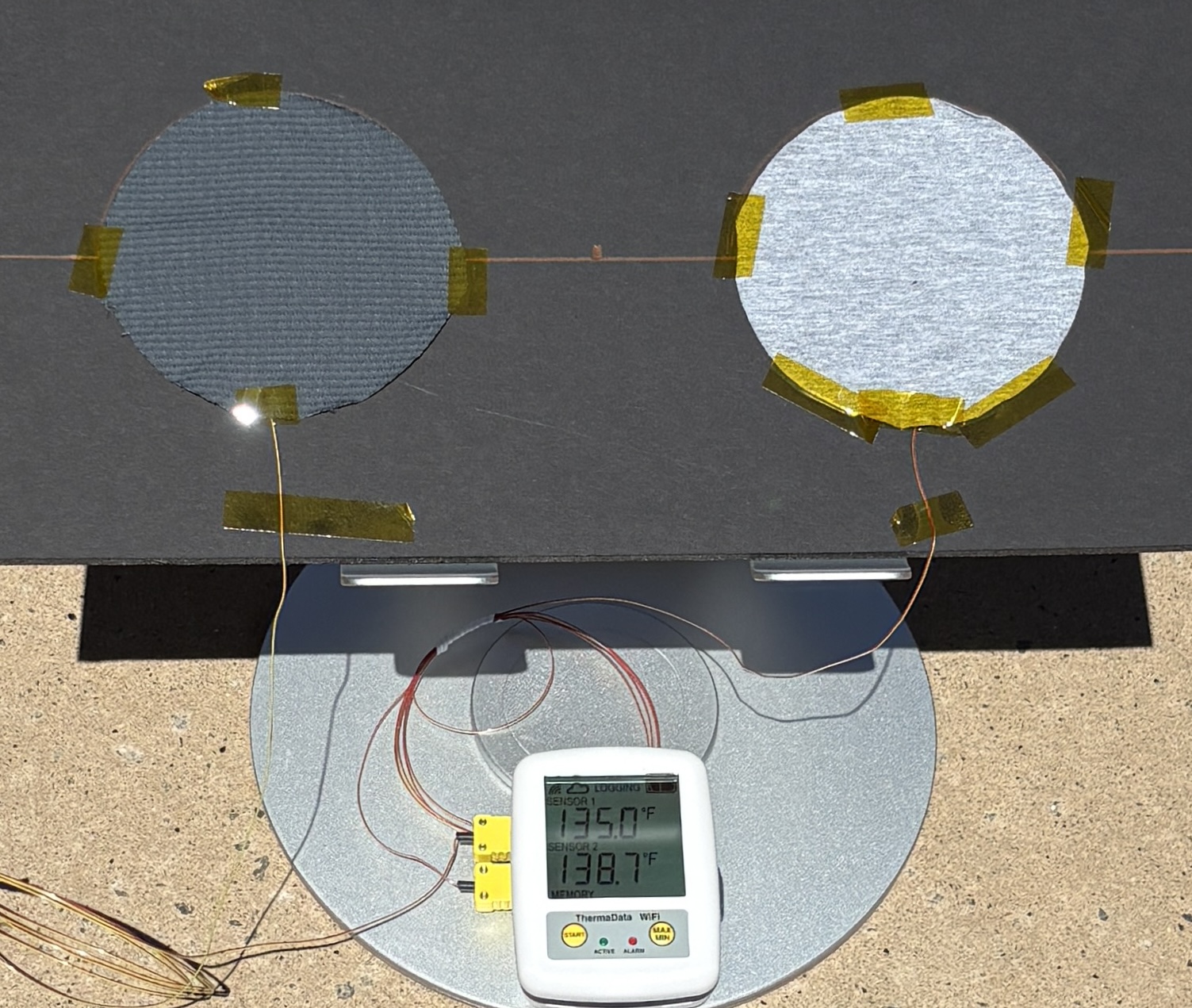
Two bench comparisons on a black absorptive panel with a thermocouple under the fabric. A UV2RED fabric ran cooler than its comparison fabric in both — by 8.4 to 12.7 °F against a dyed-to-match control, and by 3.7 °F against a lighter-coloured commercial sun-protection knit.
- Setup
- Black absorptive panel, K-type thermocouple beneath the fabric, ThermaData WiFi logger. Direct sun, outdoors.
- Solar irradiance
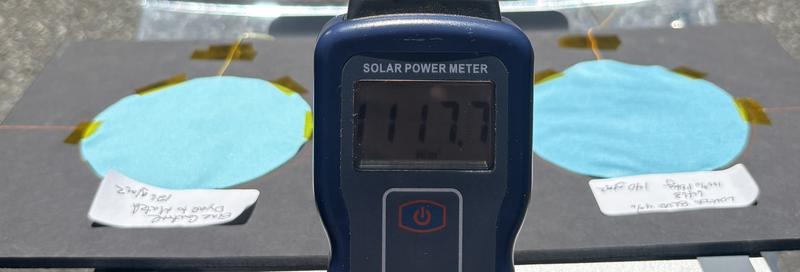
- 1,117.7 W/m²
- Ambient baseline
- 69.4 °F – 71.6 °F; indoor fabric baseline equal for both samples
- Test 1 result
- Under-fabric 99.0–105.3 °F (UV2RED) vs 108.0–117.7 °F (control): −8.4 to −12.7 °F
- Test 2 result
- Halo Midnight Sun mesh 135.0 °F vs Coolibar Heather Grey knit 138.7 °F: −3.7 °F (2.7% cooler). One reading. A dark UV2RED fabric measured cooler than a lighter conventional one.
Full reading table, photo documentation and notes in Go deeper.
Why these wavelengths matter
Red and near-infrared light, studied for decades
Red and near-infrared light — roughly 600 to 1,000 nm — is the band used in photobiomodulation: the field that studies the effects of low-level red and near-infrared light on cells and tissue. Most of that research uses lamps, lasers or LED panels at controlled doses.
Red/NIR light is studied for effects involving
- Cellular energy productionAbsorption by cytochrome c oxidase in mitochondria, associated with changes in ATP production.
- Nitric-oxide signalling and circulationRed/NIR can release nitric oxide from its binding sites; associated with local blood flow.
- Skin biologyStudied in dermatology for wound healing and skin appearance.
- Exercise and recoveryStudied before and after exercise for muscle performance, fatigue and recovery.
- Inflammatory signallingStudied for anti-inflammatory effects across a range of tissues.
Dose matters. Photobiomodulation shows a biphasic dose response: too little does nothing, too much can inhibit. Effects depend on wavelength, irradiance, exposure time, distance, tissue and total dose. Sources are linked in Go deeper.
1 · General photobiomodulation research
Peer-reviewed, device-based, controlled doses. This is where the biology above comes from. It is not research on clothing.
2 · Lightsmart textile measurements
Optical and thermal measurements of fabrics — the tests on this page. They show the fabric generates red/NIR in this band. They do not measure a biological outcome.
3 · Lightsmart clinical or observational research
None is included on this page. We are not saying that wearing Lightsmart reproduces the results of device studies: sunlight-driven output is not a controlled dose.
The products
The same yarn, two garments
Halo is Lightsmart's line built on UV2RED yarn. The shirt is a knit; the cap is a woven. Both work the same way. Their output does not have to be the same.
Halo FS1 · Lumen Mist
Halo FS1
A full-coverage sun shirt whose fabric rates UPF 50+ and generates red/NIR wherever sunlight reaches it.
Halo cap · Steel Grey
Halo cap
The woven fabric family tested above (Midnight Sun woven) is the same construction class. Shirt measurements are not applied to the cap, or the cap's to the shirt.
The measurements on this page were made on the fabrics named in each test: Halo Midnight Sun mesh and woven, Lumia Blue, Alpin Midnight Sun Heather, and the lab-tested jersey and mesh constructions. Output for a specific garment and colour varies with:
- Fabric constructionknit or woven, density, weight
- Photonic-fiber concentrationshare of UV2RED yarn in the blend
- Colour and pigmentcolour changes absorption and emission
- Sunlight intensitytime of day, season, cloud, shade
- Garment positionangle to the sun, layering, fit
- Measurement geometrywhere and how the reading is taken
Go deeper
Instruments, methods, full data
Everything above stands on its own. This is for anyone who wants to check the work.
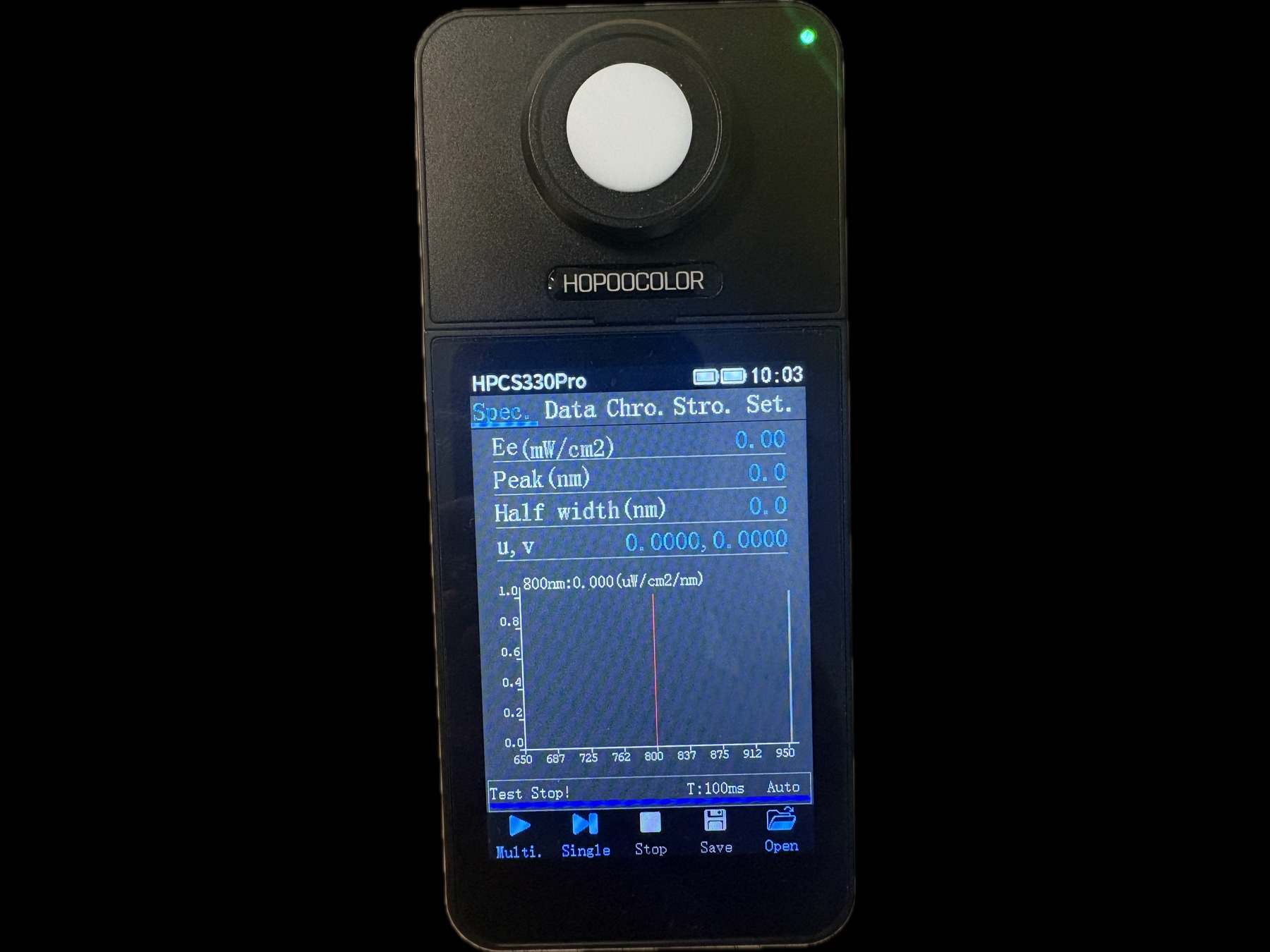
Instrumentation3 instruments
Every figure on this page is a physical measurement, not a model.
Thermal
ThermaData WiFi data logger with a K-type thermocouple positioned beneath the fabric on a black absorptive panel. Solar irradiance at the panel was read as 1,117.7 W/m².
Filter methodology650 nm short-pass
A short-pass filter transmits wavelengths shorter than its cut-off and blocks longer ones. Placed between the LED source and the fabric, a 650 nm short-pass filter lets the UV, violet, blue and green light through and removes the red and near-infrared. The detector is then read only in the 650–950 nm window.
- If the fabric merely transmits or reflects light, the 650–950 nm reading stays near zero — there is nothing in that band to transmit. That is the control result: 0.01 mW/cm².
- If the fabric absorbs shorter-wavelength light and re-emits at longer wavelengths, the detector sees it. That is the UV2RED result: 1.87 mW/cm², peaking at 776 nm.
- The test is designed to answer one question — is the fabric generating red/NIR? — under a laboratory source. It does not replicate outdoor irradiance, angle or distance.
Full spectrawoven fabrics · hat comparison
Three woven constructions under sunlight
Same yarn platform, three colours, three emission profiles. Measured under real sunlight with the HPCS330Pro; no filter. Ee is irradiance in mW/cm²; FWHM is the width of the emission band at half its peak.
| Woven fabric | Peak | Ee (mW/cm²) | FWHM | Profile |
|---|---|---|---|---|
| ● Skywave | 756 nm | 4.67 | 98.1 nm | Higher-intensity output |
| ● Midnight Sun + Skywave 50/50 | 774 nm | 2.60 | 106.8 nm | Balanced |
| ● Midnight Sun | 784 nm | 1.84 | 119.8 nm | Deeper near-infrared bias |
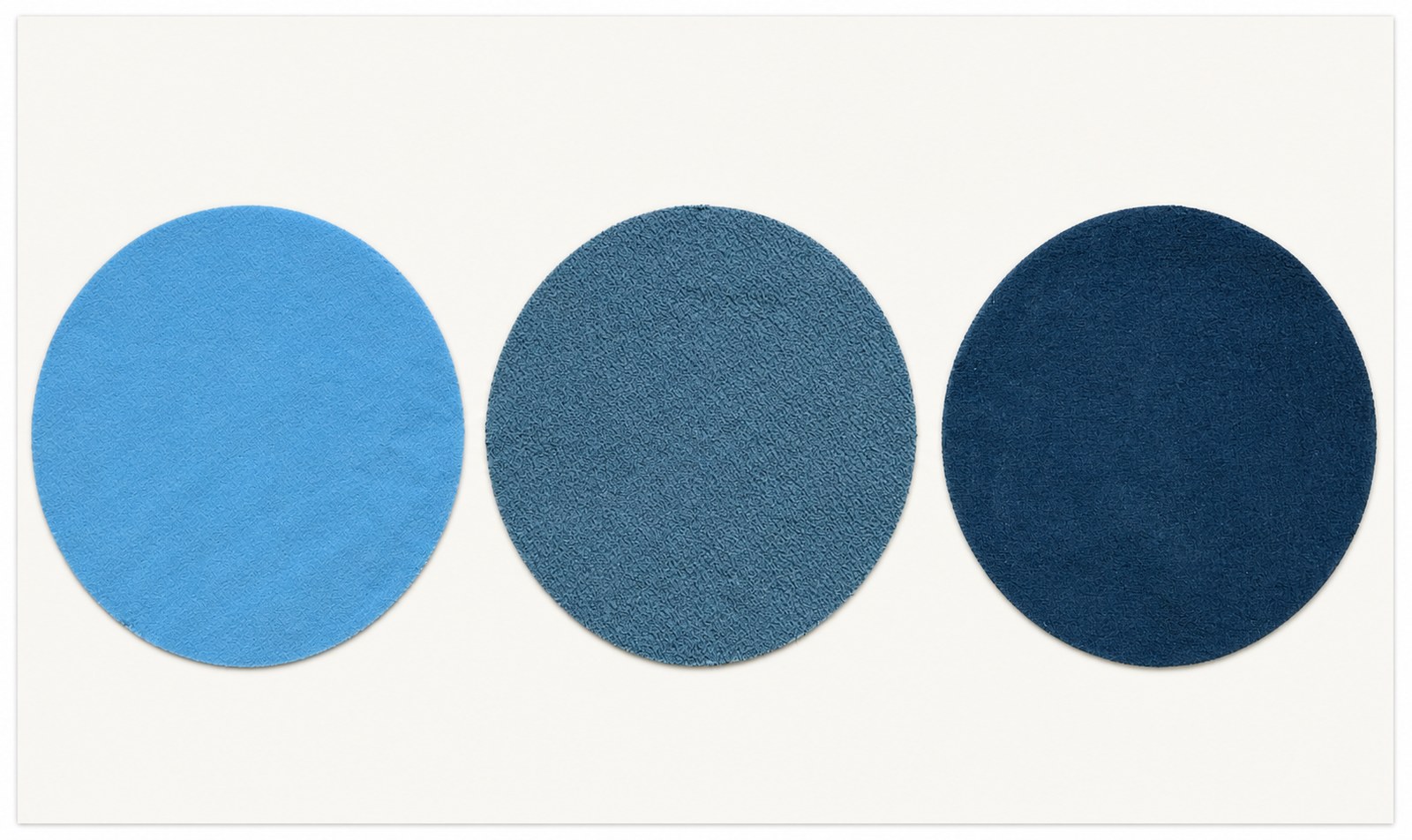
Curves are generated from the measured peak and FWHM (as in the source record). Heights are scaled so each curve's area is proportional to its measured Ee. Colour changes both how much is emitted and where the band sits.
Woven fabric versus a standard hat
A separate comparison recorded Midnight Sun woven fabric at 1.87 mW/cm² of red/NIR against 0.27 mW/cm² for a standard hat over 650–900 nm — about seven times more. The record does not state the date, filter or lighting conditions for that comparison, so we list it here rather than in the main text. It says nothing about the direction the light travels.
Field-test conditionsoutdoor readings
| Test | Fabric | Where · when | Conditions recorded |
|---|---|---|---|
| Red/NIR at skin side (+32%) | Alpin Midnight Sun Heather leggings, 43% photonic PET | Charlotte, NC · date not recorded | Outdoor, full sun. HPCS330Pro. Total through-fabric red/NIR and UV2RED contribution isolated. |
| Woven emission profiles | Skywave, 50/50, Midnight Sun (woven) | Location and date not recorded | Real sunlight. HPCS330Pro, unfiltered. Peak, Ee, FWHM. |
| Thermal, Test 1 | Lumia Blue 4% vs dyed-to-match control | Date not recorded | Direct sun, 1,117.7 W/m². Black panel. Thermocouple beneath fabric. Ambient 69.4–71.6 °F. |
| Thermal, Test 2 | Halo Midnight Sun mesh vs Coolibar Heather Grey knit | Date not recorded | Direct sun, outdoors. Same setup. Single reading. |
| Filter bench test | Halo Midnight Sun mesh vs Nike Pro dark grey | Charlotte, NC · Jan 27, 2026 | Indoor. Labsphere LED, 650 nm short-pass, HPCS330Pro. |
Where a field is blank, the source record does not contain it. We have not filled gaps.
UPF laboratory reports13 reports
Accredited third-party laboratories, AATCC TM 183 (erythemally weighted UV transmittance). All 13 rated UPF 50+.
| Fabric / colour | Report | Laboratory | UPF | Rating | UV-A block | UV-B block | Date |
|---|---|---|---|---|---|---|---|
| 92% Polyester / 8% Spandex Jersey SU-S3878A Haze | TWNT02198274 | Intertek Taiwan | 973.66 | UPF 50+ | 99.48% | 99.95% | Nov 08, 2024 |
| 92% Polyester / 8% Spandex Jersey SU-S3878B Tidalwave | TWNT02198274 | Intertek Taiwan | 285.32 | UPF 50+ | 96.88% | 99.94% | Nov 08, 2024 |
| 93% Polyester / 7% Spandex Mesh Jersey SU-S3910A Haze | TWNT02198282 | Intertek Taiwan | 110.75 | UPF 50+ | 97.45% | 99.51% | Nov 08, 2024 |
| 93% Polyester / 7% Spandex Mesh Jersey SU-S3910S Shockwave | TWNT02199359 | Intertek Taiwan | 87.54 | UPF 50+ | 97.81% | 99.14% | Nov 18, 2024 |
| 92% Polyester / 8% Spandex Jersey SU-S3878S Shockwave | TWNT02199362 | Intertek Taiwan | 1,515 | UPF 50+ | 99.74% | 99.95% | Nov 18, 2024 |
| Lumia Orange S17068n40 | 38684 | Precision Testing Labs | 104.52 | UPF 50+ | 97.53% | 99.41% | Apr 17, 2018 |
| Lumia Orange S27068s20 | 38685 | Precision Testing Labs | 2,000 | UPF 50+ | 99.95% | 99.95% | Apr 17, 2018 |
| Lumia Violet S27068s20AS — Arm Sleeve | 38686 | Precision Testing Labs | 99.72 | UPF 50+ | 99.72% | 99.95% | Apr 17, 2018 |
| Lumia Violet S27068s40WS — Wrist Sleeve | 38687 | Precision Testing Labs | 1,969 | UPF 50+ | 99.93% | 99.95% | Apr 17, 2018 |
| Lumia Blue 6643 | 41575 | Precision Testing Labs | 107.84 | UPF 50+ | 94.91% | 99.88% | Feb 11, 2019 |
| Lumia Blue CX7548 | 41576 | Precision Testing Labs | 64.89 | UPF 50+ | 93.34% | 99.15% | Feb 08, 2019 |
| NF-65 Rose | 49305 | Precision Testing Labs | 191.75 | UPF 50+ | 98.41% | 99.71% | Oct 05, 2021 |
| NF-67 Blue | 49306 | Precision Testing Labs | 105.39 | UPF 50+ | 98.13% | 99.28% | Oct 05, 2021 |
UPF is an uncapped ratio; values well above 50 indicate essentially complete blocking and should be read as "≥50+".
Thermal resultsfull readings
| Reading | UV2RED · Lumia Blue | Control | Δ | Note |
|---|---|---|---|---|
| Baseline — bare panel | 69.6 | 69.4 | −0.2 | Indoor, no fabric |
| Baseline — fabric, indoor | 71.6 | 71.6 | 0.0 | Indoor, no UV input |
| B1 · 1 | 99.0 | 108.0 | −9.0 | Outdoor sun |
| B1 · 2 | 99.3 | 108.5 | −9.2 | |
| B1 · 3 | 99.3 | 108.5 | −9.2 | Equilibrium reached |
| B2 · 1 | 104.4 | 113.0 | −8.6 | |
| B2 · 2 | 104.4 | 112.8 | −8.4 | |
| B2 · 3 | 104.4 | 117.1 | −12.7 | Control still climbing |
| B2 · 4 | 105.3 | 117.7 | −12.4 | Final reading |
Lumia Blue 4% (C4L3, 100% polyester, 140 g/m²) versus a blue control dyed to match (126 g/m²). The UV2RED sample is the heavier of the two. The source record attributes the difference to conversion; weave, dye chemistry and air gap were not separately controlled, so treat the mechanism as indicated, not established.
Test 2 · dark UV2RED versus light control
| Reading | Halo Midnight Sun mesh | Coolibar Heather Grey knit | Δ | Note |
|---|---|---|---|---|
| Outdoor sun · 1 | 135.0 | 138.7 | −3.7 | 2.7% cooler · single reading |
Photo documentation
How output relates to dosearithmetic, with caveats
Irradiance accumulates over time. The conversion is simple: mW/cm² × 3.6 = J/cm² per hour. Photobiomodulation studies commonly discuss doses in the single-digit J/cm² range; a figure of 4–10 J/cm² is often referenced. Using the woven readings above:
| Woven fabric | Ee at the fabric | Time to 5 J/cm² | Time to 10 J/cm² |
|---|---|---|---|
| Skywave | 4.67 mW/cm² | ~18 min | ~36 min |
| 50/50 blend | 2.60 mW/cm² | ~32 min | ~64 min |
| Midnight Sun | 1.84 mW/cm² | ~45 min | ~90 min |
Caveats. These are irradiance values measured at the fabric under the recorded sunlight, not dose delivered to tissue. The reference range comes from device studies with fixed wavelengths, distances and durations; it is not a Lightsmart dosing claim. Skin, garment fit, angle and cloud all change what actually arrives. We include the arithmetic because people ask for it, not as a target.
Scientific referencesprimary sources
Photobiomodulation — mechanisms and reviews
- de Freitas LF, Hamblin MR. Proposed mechanisms of photobiomodulation or low-level light therapy. IEEE J Sel Top Quantum Electron. 2016;22(3):7000417. PMC5215870
- Hamblin MR. Mechanisms and mitochondrial redox signaling in photobiomodulation. Photochem Photobiol. 2018;94(2):199–212. PMC5844808
- Hamblin MR. Mechanisms and applications of the anti-inflammatory effects of photobiomodulation. AIMS Biophys. 2017;4(3):337–361. doi:10.3934/biophy.2017.3.337
- Ferraresi C, Huang YY, Hamblin MR. Photobiomodulation in human muscle tissue: an advantage in sports performance? J Biophotonics. 2016;9(11-12):1273–1299. PMC5167494
- Huang YY, Chen AC, Carroll JD, Hamblin MR. Biphasic dose response in low level light therapy. Dose Response. 2009;7(4):358–383. doi:10.2203/dose-response.09-027.Hamblin
- Dompe C, et al. Photobiomodulation — underlying mechanism and clinical applications. J Clin Med. 2020;9(6):1724. doi:10.3390/jcm9061724
- Lohr NL, et al. Enhancement of nitric oxide release from nitrosyl hemoglobin and nitrosyl myoglobin by red/near infrared radiation. J Mol Cell Cardiol. 2009;47(2):256–263. doi:10.1016/j.yjmcc.2009.03.015
UV protection and sunlight
- AATCC TM183 — Transmittance or Blocking of Erythemally Weighted Ultraviolet Radiation through Fabrics. aatcc.org
- Skin Cancer Foundation — Sun-protective clothing and UPF. skincancer.org
- NREL — Reference solar spectral irradiance, ASTM G-173. nrel.gov
Lightsmart test records
Filter bench test (Charlotte, NC, Jan 27, 2026); outdoor red/NIR uplift test (Charlotte, NC); woven emission profiles; thermal comparisons; 13 UPF laboratory reports (Intertek Taiwan TWNT02198274, TWNT02198282, TWNT02199359, TWNT02199362; Precision Testing Labs 38684–38687, 41575, 41576, 49305, 49306). Copies of laboratory reports are available on request via lightsmart.tech.
Limitationsread before quoting
- Small samples. Most results are single fabrics measured in single sessions. They demonstrate the effect; they are not population statistics.
- Bench versus body. The filter test and thermal tests were run on swatches over instruments or panels, not on people wearing garments.
- Directionality was not measured. We do not know what share of generated light leaves toward the skin versus away from it.
- Optical, not biological. The measurements show the fabric emits red/NIR. They do not measure any effect on the wearer.
- Confounds in thermal tests. Paired fabrics differ in weight and construction, not only UV2RED content.
- Curve shapes. Spectral curves on this page are generated from measured peak and width values, as in the source record, not traced from raw spectrometer exports.
- Product transfer. Results from one construction or colour (knit, woven, mesh) do not transfer to another. Colour-specific data for the garments shown is not on this page.
- Missing fields. Some tests lack a recorded date or location. Where that is so, the field is omitted, not estimated.
Technical FAQ9 questions
- Is UV2RED a coating or a treatment?
- No. It is a photonic material incorporated into the polyester fiber itself when the yarn is made. There is no coating or finish to wear off.
- Does it need charging, a battery or an app?
- No. It needs light. There is nothing to charge and nothing to do.
- Is "187×" how much more red light I get?
- No. It is the ratio of two readings in a filtered bench test where the control reads essentially zero. It proves the fabric generates red/NIR; it does not describe your exposure in sunlight. The outdoor figure is +32%.
- Is UPF the same thing as conversion?
- No. UPF measures how much UV does not pass through. Conversion measures how much red/NIR the fabric generates. The fabric is rated UPF 50+ and, separately, measured to generate red/NIR.
- Does all the blocked UV become red light?
- No. Some is reflected or scattered; some absorbed energy becomes heat; a portion is re-emitted as red/NIR.
- Does it work through dark colours?
- The three woven colours measured all emitted red/NIR, with different peaks and intensities. Colour changes the result; it does not switch it off.
- Does it work indoors?
- The bench test used a laboratory UV/short-wave source, so the mechanism does not require the sun. Output under ordinary indoor lighting has not been measured on this page.
- Is this the same as a red-light panel?
- No. Panels deliver a fixed wavelength at a controlled distance and dose. Fabric output is driven by sunlight and varies with it. The research base cited above is from devices.
- Is UPF 50+ a substitute for sunscreen?
- UPF applies to the skin the fabric covers. Exposed skin still needs protection.
The one-page version
The mechanism, the three steps, the filter test, the qualified numbers and the sources — on one page, with a QR code back to this site. Made for forwarding and printing.